



Will you choose lead or steel? Ballast helps you decide.
When you need ballast for a technical application such as a machine, vessel or structure, choosing the right material is crucial. Often, the choice comes down to two options: lead ballast or steel ballast. Both materials have their own advantages, depending on the purpose, available space, costs and the environment in which they are used. In this blog, you’ll read exactly what to consider when making this choice.
Lead vs steel: the difference in weight
The biggest difference between lead and steel lies in their density. Lead, at 11.34 kg per dm³, is significantly heavier than steel, which sits at 7.85 kg per dm³. This means you can achieve more weight in less space with lead. Imagine needing to fill a container with ballast. When filled entirely with steel, the total weight will be lower than if that same container were filled with lead.
This makes lead particularly suitable for situations where compactness and maximum mass are essential. For example, stabilising machines in tight spaces or applications where space literally costs money.
When should you choose lead as ballast?
Lead is a smart choice when space is limited but high weight is still required. Think of machines or structures where the weight needs to be concentrated over a small area. Lead is also widely used in shipping, for example as keel weight. Its high density creates a low centre of gravity and therefore greater stability on the water.
Additionally, lead is naturally corrosion-resistant. Unlike steel, it does not corrode in salty or humid environments, which makes it ideal for maritime applications or outdoor use without protective coatings.
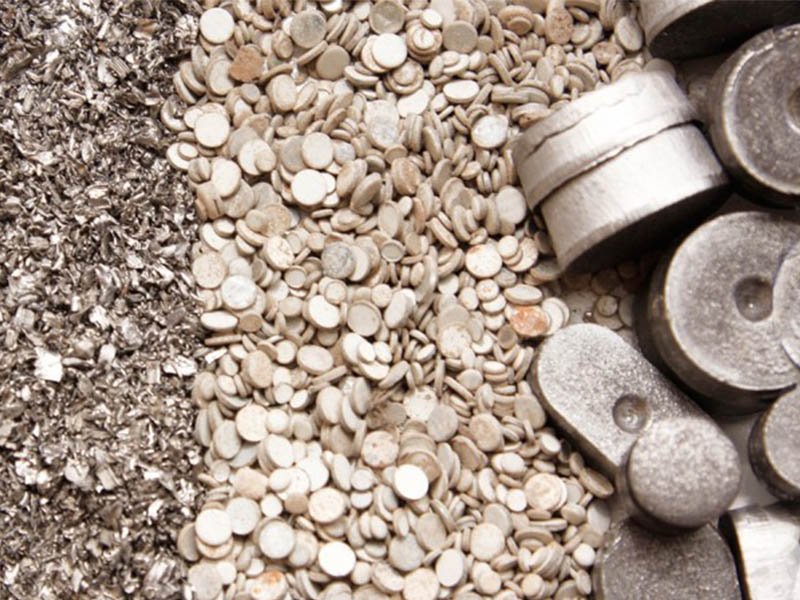
Another advantage of lead is its versatility in shape. The material can be cast easily into various forms such as punchings, billets or custom-made blocks. This makes it easier to fit into a specific construction.
When should you choose steel as ballast?
Steel is often chosen for its excellent price-to-performance ratio. It is usually more affordable than lead, especially in large volumes, making it a cost-effective ballast option when sufficient space is available.
Another advantage of steel is its structural strength. The material is sturdy and suitable for use in load-bearing constructions. Steel is also durable in terms of sustainability: it is fully recyclable and retains its quality, making it a circular choice.
However, it is important to be aware that steel is sensitive to corrosion, especially in salty or humid conditions. In such cases, steel must be treated or coated.
Making the choice: together with the customer
In many ballast projects, the choice between lead and steel is not a standard question. Together with the customer, we usually assess the situation based on drawings, sketches and objectives. What do you want to achieve? How much space is available? Does the material need to be corrosion-resistant? This analysis ultimately determines the right solution.
What fits your situation best?
Whether you choose lead or steel depends entirely on the specific conditions of your project. When available space is limited, lead is often the best option due to its higher density. In environments where moisture or salt plays a role, such as in maritime or outdoor applications, lead is also the logical choice because of its natural resistance to corrosion.
Steel, on the other hand, is attractive when budget is important or when there is enough space to compensate for its lower density. It also offers structural strength and is a sustainable choice thanks to its high recyclability.
In short: if you have limited space and need maximum mass, lead is the best option. If you have more volume available and are looking for an affordable and robust solution, steel is an excellent alternative. Unsure? Get in touch with us. We’ll be happy to assess the best solution based on your drawings or situation.